32, 64 or 128 channels? Choosing an EEG system for your research
It is one of the first questions we discuss when preparing a quote. The answer depends on what you want to measure, who your participants are and how much time you have to prepare each person.
In short: For classic ERP studies 32 electrodes are often enough – the open ERP CORE dataset was recorded with 30 electrodes. 64 channels are a sensible standard for a lab running many projects. 128 channels make sense for source analysis and detailed topography.
32 channels: classic ERP and quick studies
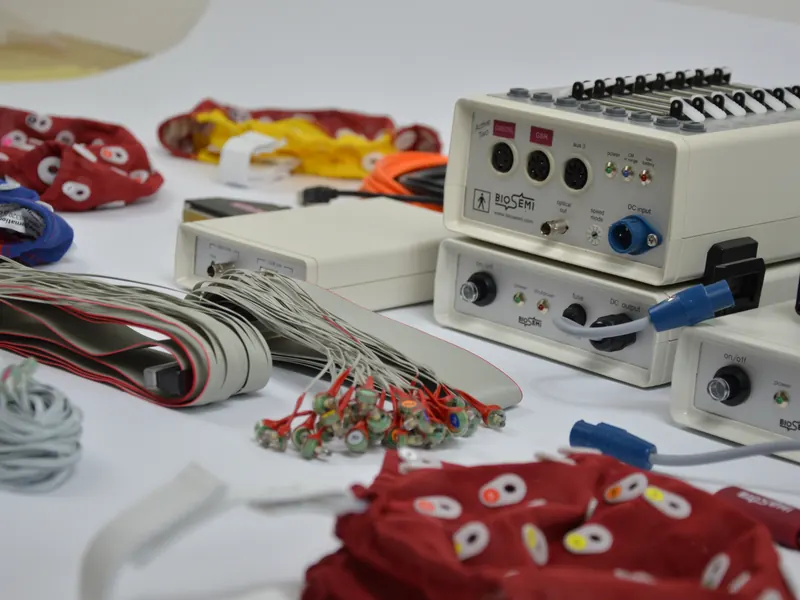
For many event-related potential studies 32 electrodes are enough. A good example is ERP CORE, an open set of paradigms and data from the team of Steven J. Luck and Emily Kappenman. It was recorded on a BioSemi ActiveTwo system with 30 scalp electrodes, sampled at 1024 Hz (Kappenman et al., 2021).
Choose 32 channels when you are interested in specific components at known locations (e.g. P3, N400, N170), when you test many people in a short time, or when you work with groups who do not tolerate long preparation well.
64 channels: the lab standard
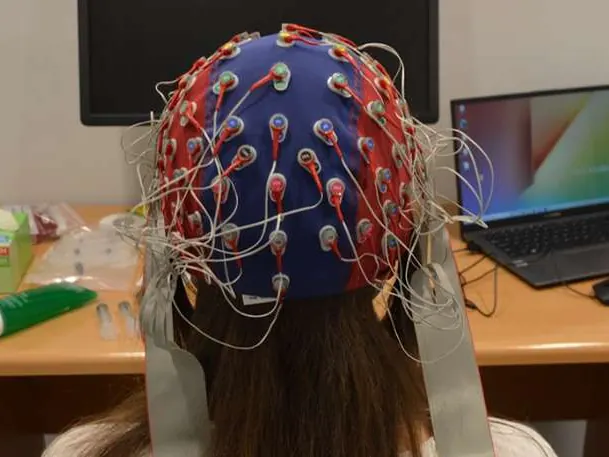
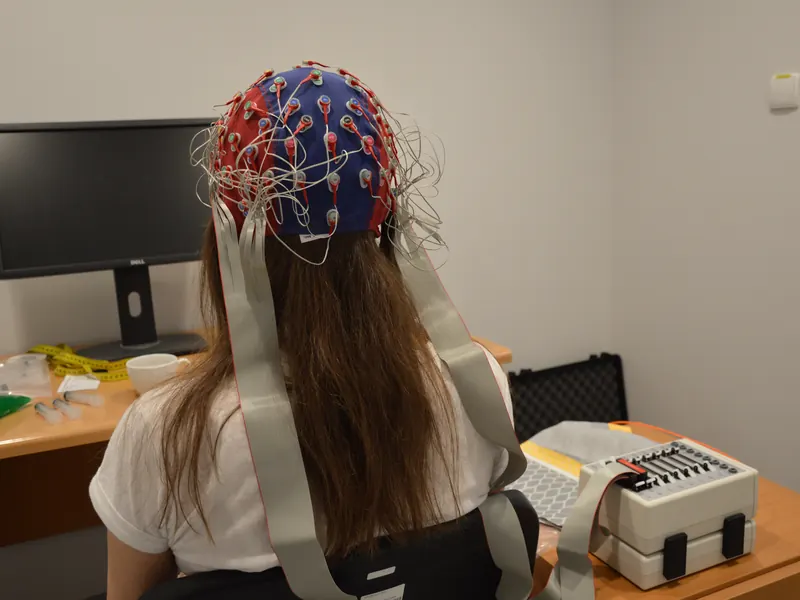
If your lab runs several projects, 64 channels are a sensible choice. The electrodes cover the head more densely, so topographic maps are more accurate and independent component analysis (ICA) has more data to work with. You also have room for studies you have not planned yet. For source localisation at least 64 electrodes are usually recommended.
An ActiveThree module can be expanded later by buying additional electrode sets. When buying with a grant, a common approach is to start with 64 channels and keep the option to expand to 128.
128 channels: high density
128 electrodes make sense for source analysis, detailed topography and connectivity studies. The trade-off is longer preparation, more gel and a higher risk of gel bridges between closely spaced electrodes. Recordings like these require an experienced team.
Do not forget the external channels
ActiveThree has eight external channels. They are usually used for:
- horizontal and vertical EOG, to detect eye movements and blinks,
- mastoid electrodes for re-referencing later,
- EMG or ECG, if the study requires it.
When planning the number of channels, count them together: scalp EEG plus external channels plus AUX inputs for other sensors.
Children and infants
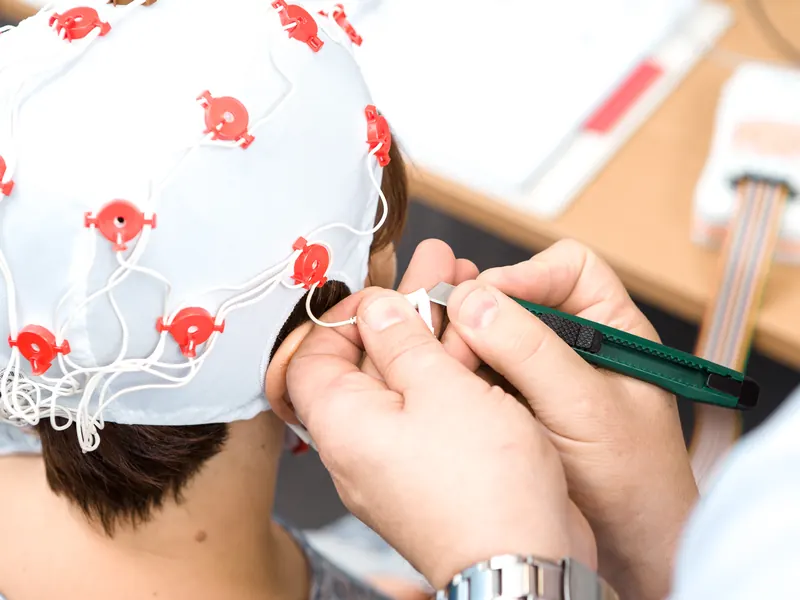
In infant studies time is what counts. BioSemi caps are available from a head circumference of 22 cm, but the smallest sizes have only 32 or 64 electrode positions. Active electrodes help, because there is no need to abrade the skin. Even so, it is often better to have fewer channels and shorter preparation than a full cap and a child who cannot last until the end of the task.
How much data you will record
The BDF format stores each sample in 3 bytes. With 72 channels (64 + 8) sampled at 2048 Hz, that is about 1.6 GB per hour of recording. With 128 channels at 16 kHz the files are more than ten times larger. Plan server space and backups before you start collecting data.
How to decide
- List the paradigms you plan to run in the next 3–5 years.
- Check how many channels were used in the most cited papers in your field.
- Estimate how much time you can spend preparing one participant.
- Leave some headroom: it is easier to buy another electrode set than to replace the system.
We are happy to work this out with you when preparing a quote. See the ActiveThree specifications.
Source: Kappenman E.S., Farrens J.L., Zhang W., Stewart A.X., Luck S.J. (2021). ERP CORE: An open resource for human event-related potential research. NeuroImage, 225, 117465. Full text

Dr Marta Szewczyk
Cognitive psychologist with a PhD in EEG/ERP research on attention (John Paul II Catholic University of Lublin). She leads BioSemi installations and teaches EEG recording.