Active electrodes and CMS/DRL: how BioSemi deals with interference
People moving to BioSemi from a system with passive electrodes usually ask the same questions: why is there no impedance reading, where is the reference electrode, and what are the two extra electrodes, CMS and DRL, for?
In short: An active electrode has an amplifier right next to the sensor, so the signal is resistant to cable movement and interference. In the CMS/DRL circuit a feedback loop takes the place of a classic ground electrode. You choose the reference (e.g. the average or the mastoids) only at the analysis stage.
What an active electrode is
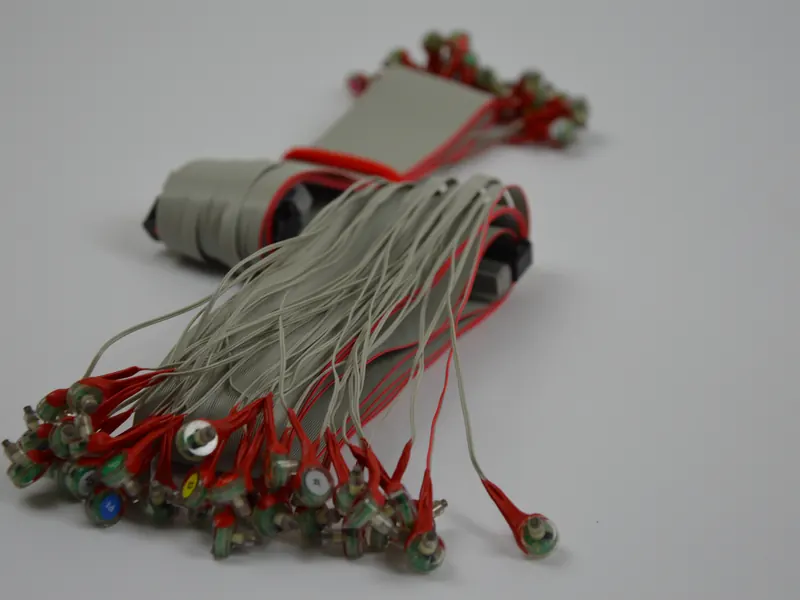
In a BioSemi active electrode the Ag/AgCl sensor has a built-in CMOS preamplifier. The signal is amplified right at the skin, before it travels along the cable. As a result, cable movement and interference from the surroundings affect it much less than with passive electrodes.
In practice this means shorter preparation. There is no need to abrade the skin to lower the impedance. You simply inject gel into the electrode holder in the cap. The BioSemi manual points out that for this reason disinfecting the electrodes is usually not necessary.
How CMS/DRL works
In a classic amplifier one electrode connects the participant's body to the amplifier ground. In BioSemi this role is taken by a pair of electrodes, CMS (Common Mode Sense) and DRL (Driven Right Leg), connected in a feedback loop.
As a result, interference common to all electrodes, such as 50 Hz mains hum, is much smaller in the raw signal. The loop also limits the current between the body and the amplifier, which is an important safety feature. The manufacturer explains it this way: the effective impedance of the DRL electrode is divided by the loop gain.
Where the reference is
The signal from each electrode is recorded relative to the point set by CMS and DRL. This is not yet the final reference. You set the actual reference, e.g. the average of all electrodes or the average of the mastoids, in the analysis by subtracting the relevant channels. ECG leads are derived the same way in BioSemi.
Important: do not analyse a recording without re-referencing it. Add this step at the start of your script, e.g. in EEGLAB, MNE or FieldTrip.
Offsets instead of impedance
ActiView does not show a classic impedance value. Contact quality is judged by the electrode offsets, i.e. the DC voltage on each channel. When an offset is high or jumps around, you adjust the gel in that holder. It is worth agreeing on a single threshold within the team and using it in every session.
After putting on the cap, wait a few minutes. According to the manufacturer's manual, the chemical reactions where electrode, gel and skin meet need time, and baseline drift and noise drop noticeably after about five minutes.
Isolation: batteries and optical fibre
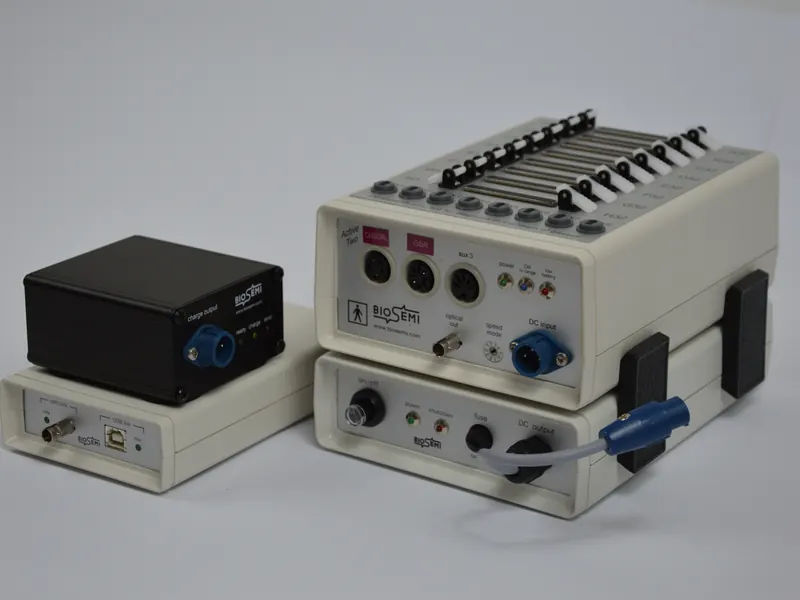
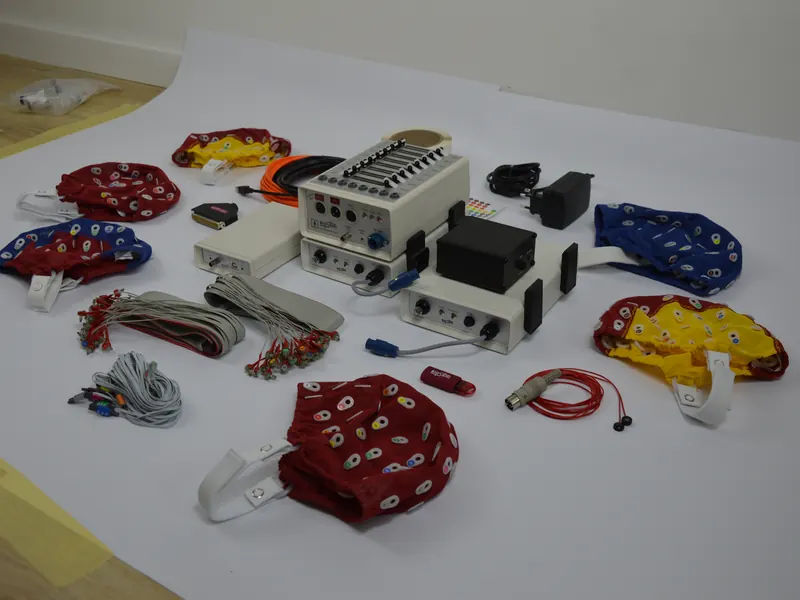
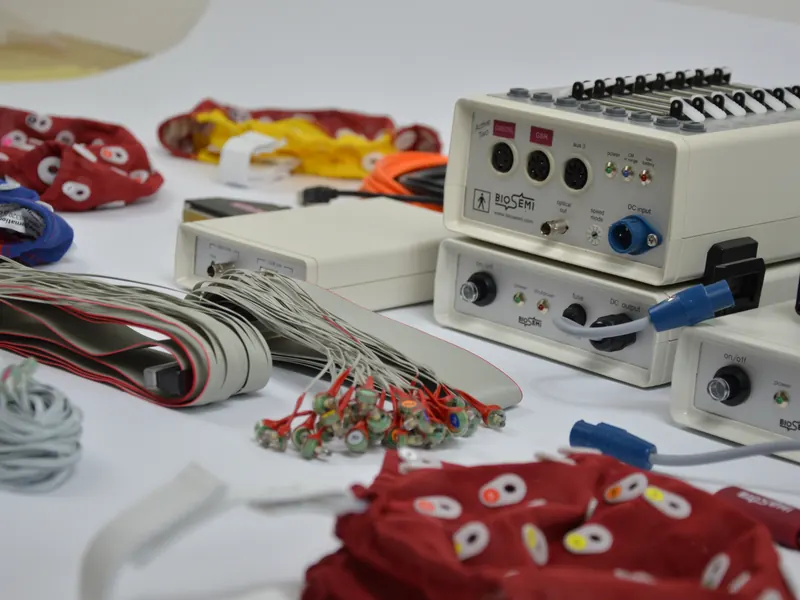
The AD-box is powered by batteries, and the data travels to the computer through an optical fibre. The participant has no galvanic connection to the mains. This is why the manufacturer warns against placing the module on a metal trolley. Metal weakens the isolation provided by the optical fibre and battery power.
You can read more about day-to-day work with electrodes in the article on caring for electrodes and caps.

Dr Marta Szewczyk
Cognitive psychologist with a PhD in EEG/ERP research on attention (John Paul II Catholic University of Lublin). She leads BioSemi installations and teaches EEG recording.